Legislative Days 26-28
Crossover Day Arrives

Today is Crossover Day, the session’s most important procedural milestone. Bills that fail to pass their chamber of origin by the end of the day are effectively lost, creating a familiar scramble at the Capitol as lawmakers work late into the night to move priority legislation.
Much of the remaining twelve days will be consumed by competing versions of tax reform. The Senate has already advanced a pair of bills to restructure the state’s income tax system. The House, meanwhile, has prioritized property tax reform. Speaker Jon Burns backed a sweeping proposal to eliminate ad valorem taxes on homesteaded property, but the plan stalled earlier this week after Democrats locked down in opposition. With affordability a defining theme of the 2026 session, the question now is whether lawmakers can bridge the partisan and chamber divides before April 2.
Interchange
SB 512 by Sen. Drew Echols, R-Gainesville, prohibits interchange fees from being assessed on the sales tax portion of credit and debit card transactions — a change CBA and other financial trade groups oppose. CBA’s position remains that this issue should be resolved at the federal level.
On Thursday, the Senate Finance Committee heard testimony on the bill. No vote was taken.
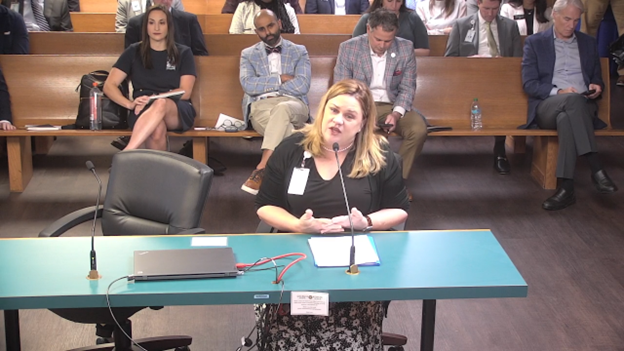
CBA’s Chief Operating Officer Lori Godfrey testified in opposition. She noted that SB 512 would increase costs for consumers, create a logistical nightmare for small businesses, and threaten the stability of the local banks that fuel Georgia’s economy.
CBA urged the committee to instead consider HB 439, which increases the vendor compensation that retailers received for the collection and remittance of state sales taxes. It is also pending before the Senate Finance Committee.
Click here to watch the committee hearing. The portion relating to SB 512 starts at 40:13 and CBA’s testimony begins at 1:01.
Interchange is a fee for a guaranteed service. Part of that service is fraud protection. If the bill passes, banks are being asked to provide the same fraud protection, the same immediate funding, and the same digital security for a portion of the transaction—the tax—completely for free. No other industry is mandated by law to provide its core service at a loss.
Active Measures: Banking

Stablecoin (HB 1272)
Rep. Todd Jones, R-Cumming
Adopted by the House on March 4
This bill creates a state-level regulatory framework for payment stablecoin issuers, aligning state law with the federal GENIUS Act. The bill requires licensure and regulation by the Department of Banking and Finance.
Transactional Gold and Silver Act (SB 424)
Sen. Marty Harbin, R-Tyrone
Placed on the Senate Rules Calendar for March 6
SB 424 provides for gold and silver specie as legal tender. It creates an electronic payment system and a bullion depository. It prohibits a social credit scoring system.
Financial Literacy (HB 1114)
Rep. Bill Yearta, R-Sylvester
Placed on the House Rules Calendar for March 6
HB 1114 allows students in ninth and tenth grade to complete the high school graduation financial literacy course requirement.
Higher Education Savings Plan (HB 962)
Rep. Chuck Martin, R—Alpharetta
Adopted by the House on March 4
HB 962 provides that the Board of Directors of the Georgia Higher Education Savings Plan shall determine the maximum contribution limit for savings trust accounts. It also modified an exemption from taxable net income for contributions to certain education savings plans.
Commerce and Trade (HB 1112)
Rep. Carter Barrett, R-Cumming
Placed on the House Rules Calendar for March 6
HB 1112 provides for rounding of the total price of the sale of goods or services when using cash. After concerns around ambiguity, it makes clear that exact-change cash payments remain acceptable.
Local Government Investment Pool (SB 441)
Sen. Marty Harbin, R-Tyrone
Assigned to the House Budget and Fiscal Affairs Oversight Committee on March 3
SB 441 requires certain pooled investments to be approved by the State Depository Board.
Remote Online Notary (HB 289)
Rep. Joseph Gullett, R—Dallas
Favorably Reported by the House Judiciary Committee on March 5
HB 289 provides for remote online notaries public and remote online notarizations. It also provides for an unfair or deceptive practice in consumer transactions in the recording of certain residential real estate documents.
Electronic Notary (HB 1437)
Rep. Houston Gaines, R-Athens
Favorably Reported by the House Technology and Infrastructure Innovation Committee on March 3
HB 1437 authorizes in-person electronic notarization (IPEN), which differs from Remote Online Notarization (RON). IPEN requires the signer and notary to be physically present while using electronic signatures and seals. RON, by contrast, allows the entire notarization process to occur via secure audio-video technology. CBA worked diligently with other interested parties to prevent any toxic amendments from being added to this bill in committee.
Active Measures: Property

Transfer on Death Deeds (HB 899)
Rep. David Jenkins, R—Grantville
Favorably Reported by the House Judiciary Committee on March 4
HB 899 would clarify, expand, and modernize the transfer-on-death deed law. The real estate planning tool lets property owners name beneficiaries who will receive property automatically upon the owner’s death, bypassing probate. The substitute removes the nine-month acceptance period.
Bona Fide Conservation Use Property (HB 547)
Rep. Chas Cannon, R—Moultrie
Placed on the House Rules Calendar for March 6
HB 547 permits the combination of multiple bona fide conservation use covenants of a single owner into a single, new, ten-year covenant
Bona Fide Conservation Use Property (SB 306)
Sen. Randy Robertson, R—Cataula
Adopted by the Senate on March 4
SB 306 requires notices of impending expiration of preferential assessment for bona fide conservation use property and bona fide residential transitional property be sent via certified mail.
Repossessors of Motor Vehicles (HB 1134)
Rep. Kimberly New, R—Villa Rica
Adopted by the House on March 4
HB 1134 revises the notice requirements for repossessors of motor vehicles.
Property Owners’ Associations (SB 406)
Rep. Matt Brass, R—Newnan
Adopted by the Senate on March 4
SB 406 requires the registration of property owners’ associations. It raises the minimum delinquency threshold for foreclosure from $2,000 to $4,000.
Property Owners’ Associations (HB 664)
Rep. Deborah Silcox, R—Sandy Springs
Adopted by the House on March 3 and assigned to the Senate Judiciary Committee on March 4
HB 664 provides for property owners' associations to submit to said article after the creation of such associations and provides for voting procedures.
Claim for Compensation for Loss of Property Value (HB 295)
Rep. Houston Gaines, R—Athens
Adopted by the House on March 4
HB 295 provides procedures for real property owners to make claims for compensation from local governments for loss of property value or expenses incurred due to the local government’s failure to comply with or nonenforcement of certain laws, ordinances, and resolutions or due to the local government maintaining a public nuisance (immigration sanctuary policies, public camping, loitering, panhandling, etc.).
Notice of Assessment (HB 275)
Rep. Bruce Williamson, R-Monroe
Placed on the House Rules Calendar for March 6
HB 275 provides for the acceptance of tax digests in the event of a publication error made by a newspaper. It revises the required information for bills and notices of assessment for ad valorem tax of property. In addition, it repeals a provision relating to the annual calculation and certification of estimated roll-back rate.
Corporate Home Ownership (SB 463)
Sen. Greg Dolezal, R—Cumming
Adopted by the Senate on March 3 and assigned to the House Judiciary Committee on March 4
SB 463 prohibits business enterprises or business enterprises controlled by natural born persons from owning an interest in more than 500 single-family residential properties. It also prohibits foreign investment vehicles from owning any interest in a single-family residential property to be used as rental property.
AI and Product Liability (SB 488)
Sen. Ed Setzler, R—Acworth
Placed on the Senate Rules Calendar for March 6
SB 488 provides that generative artificial intelligence systems shall constitute personal property for purposes of certain actions for product liability alleging injury to a minor.
Active Measures: Taxation
Eliminate Ad Valorem Tax on Timber (HR 1000)
Rep. Chuck Efstration, R-Mulberry
Postponed by the House on March 3 and 4
HR 1000 proposes an amendment to the Constitution to eliminate the ad valorem tax assessment of certain timber at sale or harvest. To make affected cities, counties, and school districts whole, the state will annually appropriate funding according to a formula.
Property Tax Reform (HR 1114)
Rep. Shaw Blackmon, R-Bonaire
Motion Lost by the House on March 3 and will be Reconsidered
If ratified by the voters, the Constitutional Amendment proposed in HR 1114 eliminates property taxes on homesteaded property statewide by 2032. Other, non-homesteaded property would continue to pay property taxes. To make up for the $5 billion in lost revenue for schools and local governments, the proposal allows those entities to repurpose existing sales taxes or charge assessments that are not tied to property value.
Georgia Taxpayer Privacy Protection Act (HB 874)
Rep. David Huddleston, R—Roopville
Placed on the House Rules Calendar for March 6
HB 874 prohibits the disclosure of taxpayer telephone numbers in property tax records sold, transferred, or shared with third parties.
Income Tax Reduction (HB 880)
Rep. Shaw Blackmon, R—Bonaire
Placed on the House Rules Calendar for March 6
HB 880 reduces the income tax rate that may be reached under certain conditions.
Deny Tax Credits for Businesses that Hire Illegal Aliens (SB 465)
Sen. Steve Gooch, R-Dahlonega
Placed on the Senate Rules Calendar for March 6
SB 465 disqualifies business enterprises that hire illegal aliens for large-scale projects from claiming certain tax credits associated with such projects.
Active Measures: Judicial

Jurisdiction and Authority of Magistrate Court (SB 405)
Sen. Ed Setzler, R—Acworth
Placed on the Senate Rules Calendar for March 6
SB 405 increases the maximum amount from $15,000 to $50,000 of civil claims that can be tried in magistrate court.
Unauthorized Practice of Law (HB 1433)
Rep. Joseph Gullett, R-Dallas
Favorably Reported by the House Judiciary Committee on March 4
HB 1433 makes certain acts of unauthorized practice of law felonies. The bill was dropped to mitigate concerns expressed with the Remote Online Notary legislation (HB 289) and ongoing discussions from past sessions.
Statewide Grand Juries (SB 607/SR 875)
Sen. Bill Cowsert, R—Athens
Placed on the Senate Rules Calendar for March 6
SB 607 establishes a statewide grand jury system focused exclusively on election-related crimes, empowering the Attorney General to investigate and indict offenses that span multiple counties. It centralizes election law enforcement authority and creates a new, state-level prosecutorial mechanism—contingent on voter approval of a constitutional amendment in 2026.
Active Measures: General Business
Automatic Renewal Provisions (HB 1224)
Rep. Carter Barrett, R—Cumming
Reported by the House Agriculture and Consumer Affairs Committee on March 5
HB 1224 reduces the applicable period for termination of certain automatic renewal provisions. It provides consumers with an option of having the service contract terminate after its specified period.
Tax Credit for Individuals (HB 1000)
Rep. Matthew Gambill, R-Cartersville
Adopted by the House on March 4
HB 1000 provides a one-time tax credit for individual taxpayers who filed income tax returns for the 2024 and 2025 taxable years. This is a key component of Governor Kemp’s final legislative package.
Georgia Small Business Healthcare Affordability Act (HB 1110)
Rep. Scott Hilton, R-Peachtree Corners
Favorably Reported by the House Ways and Means Committee on March 3
HB 1110 creates a tax credit for certain employers that offer individual coverage health reimbursement arrangements (ICHRAs) to employees. This coverage option was mentioned repeatedly during the House Blue Ribbon Study Committee on Insurance Rates that met in 2025.
Centralized Regulation (HB 1254)
Rep. Matt Reeves, R-Duluth
Withdrawn and Recommitted to the House Regulated Industries Committee on March 4
HB 1254 moves the regulation of various professions from individual boards to the Secretary of State.
Limited Liability Corporations (HB 1414)
Rep. Matt Reeves, R-Duluth
Favorably Reported by the House Judiciary Committee on March 3
HB 1414 permits the creation of protected series and registered series of a limited liability corporation. This allows a single LLC to establish multiple legally distinct sub-entities.
Temporary Door Locking Devices (SB 454)
Sen. Rick Williams, R-Milledgeville
Placed on the Senate Rules Calendar for March 6
SB 454 authorizes the use of temporary door locking devices in public buildings during certain emergency situations.
Prohibit Foreign Nationals from Contributing to any Campaign (HB 963)
Rep. Chuck Martin, R—Alpharetta
Adopted by the House on March 4
HB 963 prohibits foreign nationals from contributing to or participating in any campaign to bring about the approval or rejection by the voters of any proposed question which appears on the ballot.
Manufactured Homes (HB 377)
Rep. Rob Leverett, R—Elberton
Adopted by the Senate on March 3
HB 377 originally established specific circumstances under which a manufactured home may remain personal property rather than converting to real property. On February 12, the bill was gutted and now contains language from SB 51 regarding Qualifications Based Selection contracting. It now returns to the House for further consideration.
Categories
CBA Signature Events
Upcoming Webinars

ICBA Education Programs