2026 Legislative Days 15-18
Senate Passes Sweeping Income Tax Reform
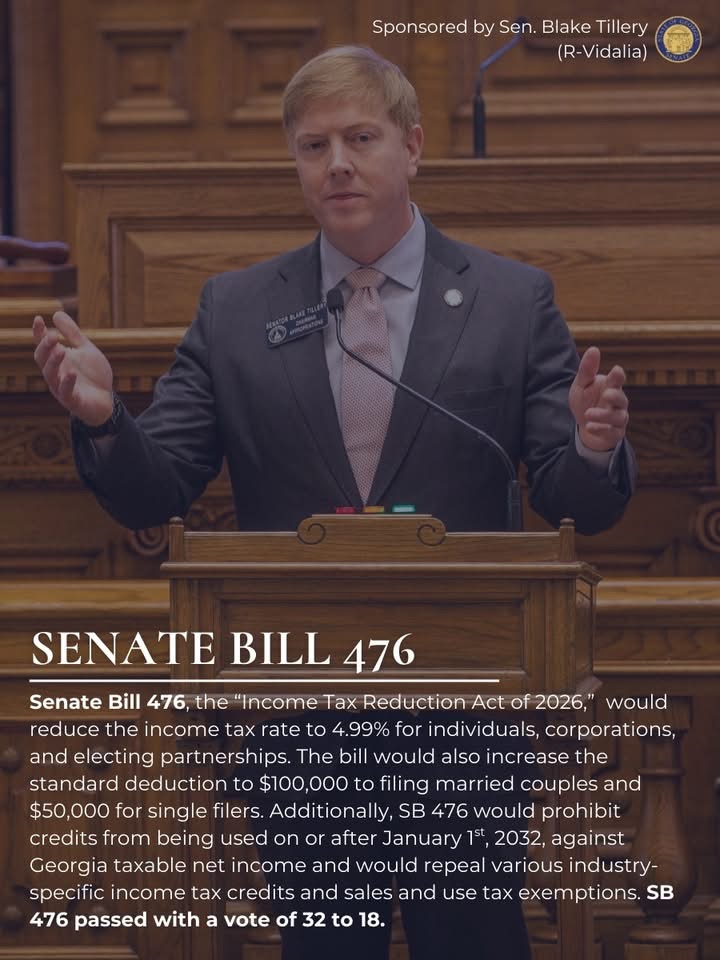
On February 12, the Senate passed several measures aimed at restructuring Georgia’s income tax system. SB 476 cuts the income tax rate to 4.99%, dramatically increases the standard deduction, and eliminates nearly all tax credits no later than 2032. The legislation eliminates the following bank-related incentives:
-
Dollar-for-dollar income tax credit for depository financial institutions,
-
Credits tied to local business license taxes on banks,
-
Credits tied to special state occupation taxes on banks.
Of particular concern for banks is the proposed repeal of the dollar-for-dollar state income tax credit for financial institutions, which could significantly affect how banks are taxed. Georgia taxes banks differently than most businesses. In addition to the state income tax, banks pay special state and local taxes on gross receipts known as the bank tax. The bank tax credit exists to prevent double taxation by ensuring banks are not required to pay both. They currently pay the greater of the bank tax or income tax. If SB 476 passes both the House and Senate in its current form, Georgia banks could be looking at a $55 million annual increase in taxes owed to the state and local governments. Click here to read the whitepaper, The Necessity of the Georgia Income Tax Credit for Depository Financial Institutions. The bill now moved to the House where there will likely be differing views on how best to deliver tax relief to Georgians.
SB 477 takes a more modest approach, reducing the income tax rate to 3.99% by 2028 and slightly increasing the standard deduction. It does not call for the wholesale elimination of tax incentives. Income tax reform is a priority of the Senate, and many of its members who are seeking higher office. These measures are expected to receive less fanfare in the House, where leaders have prioritized property tax reform.
Active Measures: Banking

Department of Banking Housekeeping (HB 945) Rep. Bruce Williamson, R-Monroe
Assigned to the Senate Banking and Financial Institutions Cmte on Feb-9
This year’s legislative housekeeping package is one of the most consequential in recent memory. The bill establishes a process to allow financial institutions to place temporary holds on transactions when they reasonably suspect financial exploitation of elderly (65+) or disabled adults. The initial hold may last up to fifteen business days, with one additional fifteen-day extension permitted. The financial institution must provide notice of the hold to both the account holder and any trusted contacts. Institutions acting in good faith receive civil, criminal, and administrative immunity.
The legislation also regulates cryptocurrency ATMs, with mandatory consumer disclosures, fee caps, and daily transaction limits. It expands the Department’s authority over litigation financiers to increase transparency and accountability; this was part of last year’s legal reform package.
The bill makes other technical changes, including:
-
Updating merger notification and approval procedures
-
Clarifying MALPB rules
-
Clarifying certain credit reporting requirements
-
Updating mortgage, installment lending, and fair lending provisions
-
Clarifying Department authority across charters and licensing regimes
-
Authorizing the Department to object to the merger or consolidation of a bank or trust
For more information, click here for a summary provided by the Department.
Securities and Commodities Regulation (HB 934) Rep. Noel Williams, R-Cordele
Favorably reported from the House Banks and Banking Cmte on Feb-5
HB 934 transfers the regulation of securities and commodities from the Secretary of State to the Department of Banking and Finance. Doing so consolidates financial regulation within the Department, a move that is intended to improve oversight and coordination. This change comes on the heels of the First Liberty Building & Loan scandal, in which the Secretary of State’s Securities Division failed to uncover misuse before federal authorities intervened.
Voluntary Portable Benefit Plan Act (HB 987) Rep. Todd Jones, R-Cumming
Pending in the House Rules Cmte
HB 987 creates a legal framework for voluntary portable benefit plans for independent contractors. It is designed to allow those workers to accumulate and manage benefits (like insurance and retirement savings) without changing their legal classification as independent contractors. It specifically authorizes banks to serve as portable benefit account providers, creating opportunities for new deposit products.
Local Government Investment Pool (SB 441) Sen. Marty Harbin, R-Tyrone
Assigned to the Senate Banking and Financial Institutions Cmte on Feb-2
SB 441 requires certain pooled investments to be approved by the State Depository Board.
Stablecoin (HB 1272) Rep. Todd Jones, R-Cumming
Assigned to the House Banks and Banking Cmte on Feb-11
This bill creates a state-level regulatory framework for payment stablecoin issuers, aligning state law with the federal GENIUS Act. The bill requires licensure and regulation by the Department of Banking and Finance.
These other banking measures are also active:
Active Measures: Property

Notice of Foreclosure (HB 948) Rep. Beth Camp, R—Concord
Adopted by the House on Feb-12
HB 948 requires that foreclosure notices include information about who can modify loan terms and how property owners can claim surplus sale proceeds.
Debtor's Aggregate Interest (HB 1024) Rep. Soo Hong, R-Lawrenceville
Pending in the House Judiciary Cmte
HB 1024 increases the exemption for a debtor's aggregate interest in real property or personal property that the debtor or a dependent of the debtor uses as a residence, in a cooperative that owns property that the debtor or a dependent of the debtor uses as a residence, or in a burial plot. The exemption increases from $21,500 to $50,000 or from $43,000 to $100,000 if it is the primary residence of both spouses. The House Judiciary Committee gave the bill a do-pass recommendation on Feb-9 but it was sent back to committee for additional work on Feb-11.
Real Estate Security and Title Act (HB 1042) Rep. Matt Reeves, R-Duluth
Favorably reported from the House Judiciary Cmte on Feb-9
HB 1042 allows secured creditors to submit credit bids at judicial sales. Purchases may pay with a cashier’s check, certified check, or other certified funds, and the foreclosing lender may submit a credit bid instead of tendering any funds. It also strengthens privacy protections for current and former judges and their spouses and increases eligibility standards for special masters in certain quiet title proceedings.
Property Owners’ Associations. Legislators in both the House and Senate are interested in reforming predatory practices of property owners’ associations (POAs), with an emphasis on transparency and enforcement actions that threaten ownership. Several bipartisan bills are active in this space, including:
-
HB 512 to require POAs to provide annual certificates of good standing
-
HB 1219 to require all new associations be subject to the Property Owners’ Association Act
-
HB 1221 to require property owners' associations to disclose certain fines and fees before an association can collect reasonable attorney's fees.
-
HB 1222 to standardize the process for obtaining an estoppel when a property is being sold or refinanced
-
HB 1251 to require certain disclosures to unit owners.
-
SB 108 to require alternative dispute resolution prior to enforcing a lien
-
SB 361 to authorize liens and the use of assessments by property owners' associations
-
SB 393 to prohibit property owners’ associations from traffic and parking enforcement
-
SB 406 to raise the minimum delinquency threshold for foreclosure
Corporate Home Ownership. Policymakers continue to grapple with the issue of corporate ownership of single-family residential properties (SFRP). Legislators are considering a myriad of options:
-
HB 305 to prohibit large corporations from owning more than 25 SFRPs in a single county
-
HB 374 to establish housing management databases of corporate owners of more than 10 contiguous units of SFRP in a single jurisdiction
-
HB 403 to limit corporate ownership of SFRPs to no more than 12,000 units statewide
-
HB 864 to require corporations to divest all SFRP by 2030
-
HB 1017 to tax certain corporate-owned SFRP at 100% of fair market value
-
HB 1055 to prohibit certain entities from owning 25 or more SFRPs
-
HB 1115 to prohibit corporations from owning more than 2,000 SFRPs
-
HB 1252 to prohibit certain corporations from owning SFRPs
-
HR 1103 to encourage local governments to assist with reducing “Wall Street landlord ownership”
-
HR 656 to create a study committee on this topic
-
SB 313 to require a registry of owners with more than 20 residential rental properties statewide
Active Measures: Taxation
Eliminate Ad Valorem Tax on Timber (HR 1000) Rep. Chuck Efstration, R—Mulberry
Favorably reported from the House Ways and Means Cmte on Feb-11
HR 1000 proposes an amendment to the Constitution to eliminate the ad valorem tax assessment of certain timber at sale or harvest. To make affected cities, counties, and school districts whole, the state will annually appropriate funding according to a formula.
Property Tax Reform (HB 1116 / HR 1114) Rep. Shaw Blackmon, R-Bonaire
Considered by a House Ways and Means Subcmte on Feb-9
The Georgia HOME Act eliminates property taxes on homesteaded property statewide by 2032. The bill caps local property tax revenue growth at 3% for non-homesteaded property, which continues to pay property taxes. To make up for the $5 billion in lost revenue for schools and local governments, the proposal allows those entities to repurpose existing sales taxes or charge assessments that are not tied to property value.
Active Measures: Courts and Legal Reform

AI and Product Liability (SB 488) Sen. Ed Setzler, R-Acworth
Assigned to the House Judiciary Cmte on Feb-11
SB 488 defines artificial intelligence systems as personal property, allowing plaintiffs to use Georgia’s product liability statute. It allows sellers of AI to be held liable for injured minors. It establishes a rebuttable presumption that the manufacturer and the seller had a duty to warn about the risk that caused the injury.
Magistrate Court Fees and Costs (HB 999) Rep. Rob Leverett, R-Elberton
Pending in the Senate Judiciary Cmte
This legislation clarifies fees and costs associated with Magistrate Court proceedings. It also corrects a drafting error from a previous bill related to the nonpartisan election of magistrates.
Increase Magistrate Court Jurisdiction (SB 405) Sen. Ed Setzler, R-Acworth
Pending in the Senate Rules Cmte
SB 405 increases the max value of civil claims that can be tried in magistrate court from $15,000 to $50,000.
Business Litigation Reform (HB 1185) Rep. Chuck Efstration, R-Mulberry
Pending in the House Judiciary Cmte
This is business-friendly litigation reform is designed to make Georgia more attractive for incorporation and headquarters operations.
Active Measures: General Business
Disposition of Unclaimed Property (SB 403) Sen. Kay Kirkpatrick, R—Marietta
Assigned to the House Judiciary Cmte on Feb-9
SB 403 updates Georgia’s Unclaimed Property Act, including provisions addressing the treatment of virtual currency. The bill makes other administrative changes, including clarifying when property is presumed abandoned, expanding holder notice requirements, adjusting publication standards, and modernizing claims processing and payment methods.
Reduce the Income Tax Rate (HB 1001) Rep. Will Wade, R-Dawsonville
Favorably reported from the House Ways and Means Cmte on Feb-11
HB 1001 accelerates a reduction in the state income tax rate to 4.99% effective for tax year beginning January 1, 2026. This is one of Governor Kemp’s legislative priorities.
Tax Credit for Individuals (HB 1000) Rep. Matthew Gambill, R-Cartersville
Considered by a House Ways and Means Subcmte on Feb-9
HB 1000 provides a one-time tax credit for individual taxpayers who filed income tax returns for the 2024 and 2025 taxable years. This is a key component of Governor Kemp’s final legislative package.
Municipal Election Schedule (SB 422) Sen. Tim Bearden, R-Carrollton
Pending in the Senate Ethics Cmte
SB 422 requires most municipal elections to occur in even-numbered years. It provides a one-year extension to the terms of office of most municipal officers for the transition of municipalities into even-numbered year election cycles.
ICBA Capital Summit
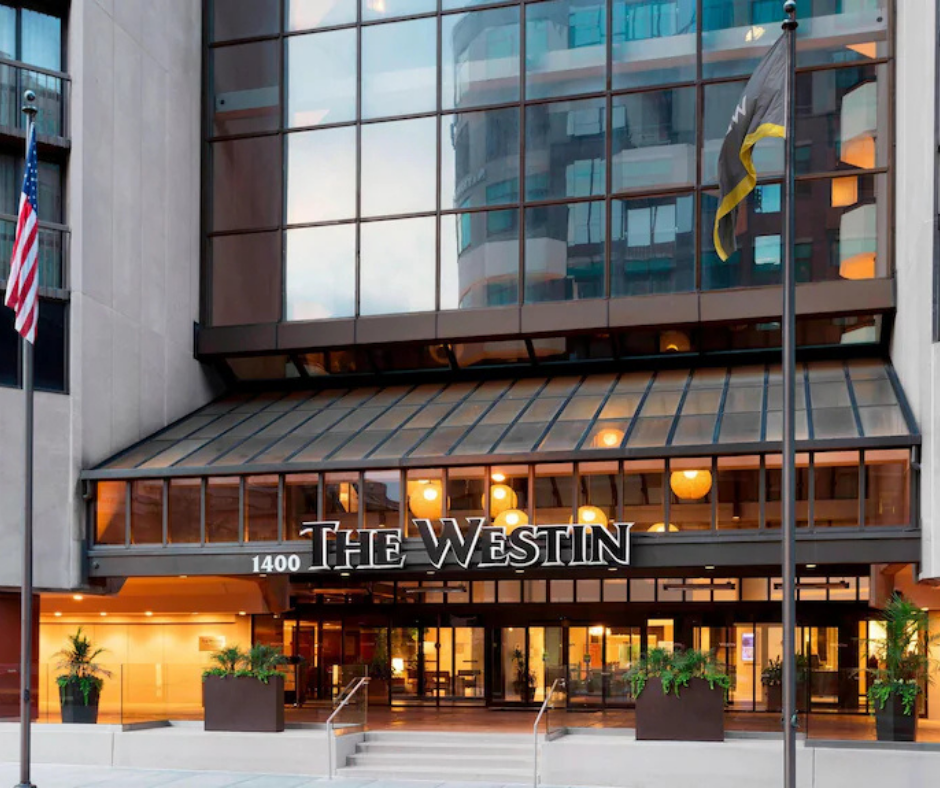
ICBA’s 2026 Capital Summit will be held May 4-7, 2026, at the Westin Washington, DC, Downtown. For more information on the Summit or to register for the event, click here.
The next legislative update will be available on February 20
Categories
CBA Signature Events
Upcoming Webinars

ICBA Education Programs