Legislative Days 23-25
Up Next: Crossover and Qualifying
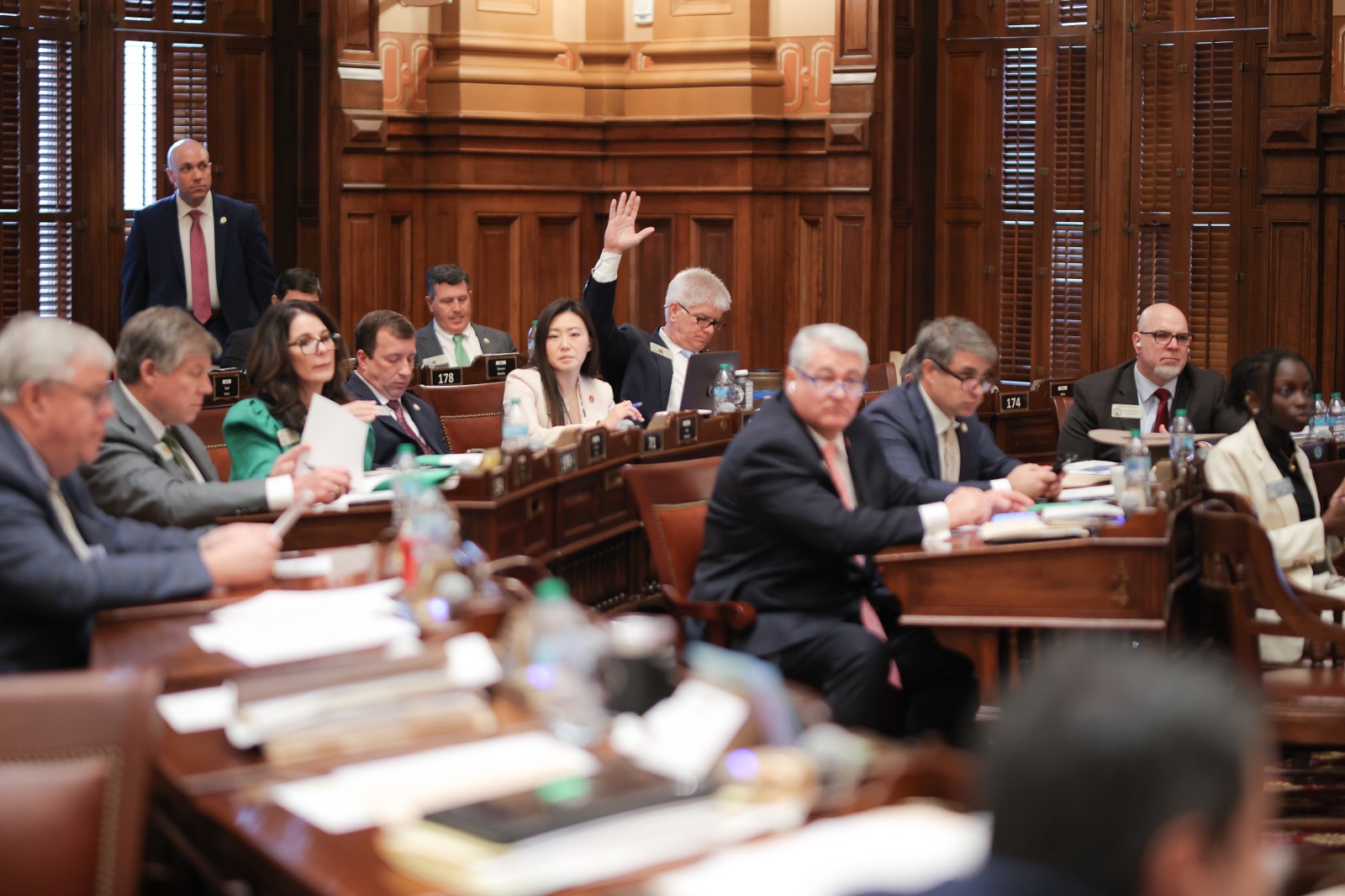
Next week will bring a uniquely chaotic environment to the Capitol. The General Assembly is racing toward Crossover Day on March 6. Crossover is the make-or-break procedural milestone that determines which bills stay alive. House bills must clear the House, and Senate bills must clear the Senate, ensuring the opposite chamber has time to consider the legislation before the 40-day session expires. Expect late nights, packed calendars, and last-minute horse trading as leaders seek to advance priority measures.
Next week is also qualifying — when the political temperature rises just as fast as the legislative one. Incumbents and would-be challengers alike make the trek to the Capitol to file paperwork, prove residency, and pay their fees. It’s the week when intentions become official and Georgia’s pivotal 2026 campaign season moves from rumor to reality.
Interchange

SB 512 by Sen. Drew Echols, R-Gainesville, prohibits interchange fees from being assessed on the sales tax portion of credit and debit card transactions — a change CBA and other financial trade groups oppose. CBA’s position remains that this issue should be resolved at the federal level. The bill is assigned to the Senate Finance Committee. CBA and other financial trade groups are encouraging Sen. Echols and members of the Senate Finance Committee to consider HB 439 relating to Vendor Compensation rather than SB 512.
On February 23, ICBA published a resource that describes payment card interchange and other swipe fees. The Interchange Guide is especially useful in helping community bankers communicate about the issue with their customers. It covers:
- The life cycle of a card transaction.
- The three parts of swipe fees: interchange, network, and acquirer.
Another article from the International Center for Law & Economics provides a legal analysis of interchange-fee regulations. Click here for the article.
Garnishments
On February 3, Chief Justice Nels Peterson issued a concurrence in Media v. Walker, urging the General Assembly to revise two sections of Georgia’s garnishment statute.
Under current law, a garnishee – often a financial institution – that fails to timely respond to a garnishment may be held liable for the full amount of the underlying judgement, often in excess of $1 million. Chief Justice Peterson noted that the statute permits default judgments against garnishees for the entire debt owned by the defendant, even when the initial garnishment amount was substantially lower.
CBA and the other financial trade associations have brought this concern to the House Judiciary Committee staff; this on their “to do” list. Unfortunately, there is likely not enough time for a bill to be drafted, vetted, and introduced this session and we expect to pursue a remedy in the 2027 session.
Active Measures: Banking

Transactional Gold and Silver Act (SB 424) Sen. Marty Harbin, R-Tyrone
Favorably Reported by the Senate Banking and Financial Institutions Committee on February 24
SB 424 provides for gold and silver specie as legal tender. It creates an electronic payment system and a bullion depository. It prohibits a social credit scoring system.
Financial Literacy (HB 1114) Rep. Bill Yearta, R-Sylvester
Favorably Reported by the House Education Sub Committee on February 23
HB 1114 allows students in ninth and tenth grade to complete the high school graduation financial literacy course requirement.
Commerce and Trade (HB 1112) Rep. Carter Barrett, R-Cumming
Favorably Reported by the House Banks & Banking Committee on February 26
HB 1112 provides for rounding of the total price of the sale of goods or services when using cash. After concerns around ambiguity, it makes clear that exact-change cash payments remain acceptable.
Disclosure of a Reportable Transaction to a Credit Agency (HB 1314) Rep. Marvin Lim, D-Norcross
Favorably Reported by the House Banks & Banking Committee on February 26
HB 1314 requires Georgia Installment Lender licensees to disclose whether a transaction is reportable to a credit reporting agency.
Local Government Investment Pool (SB 441) Sen. Marty Harbin, R-Tyrone
Adopted by the Senate on February 26
SB 441 requires certain pooled investments to be approved by the State Depository Board.
Electronic Notary (HB 1437) Rep. Houston Gaines, R-Athens
Assigned to the House Technology and Infrastructure Innovation Committee on February 25
HB 1437 authorizes in-person electronic notarization (IPEN), which differs from Remote Online Notarization (RON). IPEN requires the signer and notary to be physically present while using electronic signatures and seals. RON, by contrast, allows the entire notarization process to occur via secure audio-video technology.
Boat Titling (HB 115) Rep. Jesse Petrea, R-Savannah
Favorably Reported by the Senate Natural Resources and the Environment Committee on February 23
HB 115 pertains to the registration, operation, and sale of watercraft. It allows the Department of Natural Resources to remove, store, and dispose of abandoned vessels.
Georgia Local Government Finance Authority Act (HB 1448) Rep. Victor Anderson, R-Cornelia
Assigned to the House Government Affairs Committee on February 24
HB 1448 provides comprehensive regulation of local government assets financing. CBA believes this proposal will shift municipal financing activity away from community banks and allow local governments to borrow money from the new entity managed by the Georgia Municipal Association.
Active Measures: Property

Debtor's Aggregate Interest (HB 1024) Rep. Soo Hong, R-Lawrenceville
Adopted by the House on February 25 and assigned to the Senate Banking & Financial Institutions Committee on February 26
HB 1024 increases the exemption for a debtor's aggregate interest in real property or personal property that the debtor or a dependent of the debtor uses as a residence from $21,500 to $50,000 or from $43,000 to $100,000 if it is the primary residence of both spouses. Neil Gordon, a nationally recognized leader in bankruptcy law, urged the committee to reject the legislation, indicating it would swing the pendulum too far in favor of debtors.
Notice of Assessment (HB 275) Rep. Bruce Williamson, R-Monroe
Favorably Reported by the House Ways and Means Committee on February 24
HB 275 provides for the acceptance of tax digests in the event of a publication error made by a newspaper. It revises the required information for bills and notices of assessment for ad valorem tax of property. In addition, it repeals a provision relating to the annual calculation and certification of estimated roll-back rate.
Bona Fide Conservation Use Property (SB 306) Sen. Randy Robertson, R-Cataula
Favorably Reported by the Senate Finance Committee on February 25
SB 306 requires notices of impending expiration of preferential assessment for bona fide conservation use property and bona fide residential transitional property be sent via certified mail.
Foreclosure on Condo Lien (SB 580) Sen. Sheikh Rahman, D-Lawrenceville
Assigned to the Senate Banking and Financial Institutions Committee on February 26
SB 580 increases the minimum amount (from $2,000 to $20,000) required for a foreclosure on a lien on a property under the “Georgia Condominium Act” and the “Georgia Property Owners’ Association Act”.
Property Owners’ Associations. Legislators in both the House and Senate are interested in reforming predatory practices of property owners’ associations (POAs), with an emphasis on transparency and enforcement actions that threaten ownership. Several bipartisan bills are active in this space, including:
-
HB 512 to require POAs to provide annual certificates of good standing
-
HB 1219 to require all new associations be subject to the Property Owners’ Association Act
-
HB 1221 to require property owners' associations to disclose certain fines and fees before an association can collect reasonable attorney's fees.
-
HB 1222 to standardize the process for obtaining an estoppel when a property is being sold or refinanced
-
HB 1251 to require certain disclosures to unit owners.
-
SB 108 to require alternative dispute resolution prior to enforcing a lien
-
SB 361 to authorize liens and the use of assessments by property owners' associations
-
SB 393 to prohibit property owners’ associations from traffic and parking enforcement
-
SB 406 to raise the minimum delinquency threshold for foreclosure
Corporate Home Ownership. Policymakers continue to grapple with the issue of corporate ownership of single-family residential properties (SFRP). Legislators are considering a myriad of options:
-
HB 305 to prohibit large corporations from owning more than 25 SFRPs in a single county
-
HB 374 to establish housing management databases of corporate owners of more than 10 contiguous units of SFRP in a single jurisdiction
-
HB 403 to limit corporate ownership of SFRPs to no more than 12,000 units statewide
-
HB 864 to require corporations to divest all SFRP by 2030
-
HB 1017 to tax certain corporate-owned SFRP at 100% of fair market value
-
HB 1055 to prohibit certain entities from owning 25 or more SFRPs
-
HB 1115 to prohibit corporations from owning more than 2,000 SFRPs
-
HB 1252 to prohibit certain corporations from owning SFRPs
-
HR 1103 to encourage local governments to assist with reducing “Wall Street landlord ownership”
-
HR 656 to create a study committee on this topic
-
SB 313 to require a registry of owners with more than 20 residential rental properties statewide
Active Measures: Taxation
Eliminate Ad Valorem Tax on Timber (HR 1000) Rep. Chuck Efstration, R—Mulberry
Favorably reported from the House Ways and Means Committee on February 11
HR 1000 proposes an amendment to the Constitution to eliminate the ad valorem tax assessment of certain timber at sale or harvest. To make affected cities, counties, and school districts whole, the state will annually appropriate funding according to a formula.
Property Tax Reform (HB 1116 / HR 1114) Rep. Shaw Blackmon, R-Bonaire
Considered by a House Ways and Means Subcommittee on February 9
The Georgia HOME Act eliminates property taxes on homesteaded property statewide by 2032. The bill caps local property tax revenue growth at 3% for non-homesteaded property, which continues to pay property taxes. To make up for the $5 billion in lost revenue for schools and local governments, the proposal allows those entities to repurpose existing sales taxes or charge assessments that are not tied to property value.
Income Tax Reduction (HB 800) Rep. Shaw Blackmon, R-Bonaire
Favorably Reported by the House Ways and Means Committee on February 26
HB 800 accelerates the reduction of the state income tax rate under certain revenue triggers.
Georgia Homeownership Protection Act (HB 1035) Rep. Sandra Scott, D-Rex
Favorably Reported by the House Ways and Means Committee on February 26
HB 1035 prohibits local governments from adding unpaid service charges to the ad valorem tax roll for purposes of tax execution or tax sale of an owner-occupied dwelling.
Deny Tax Credits for Businesses that Hire Illegal Aliens (SB 465) Sen. Steve Gooch, R-Dahlonega
Favorably Reported by the Senate Finance Committee on February 25
SB 465 disqualifies business enterprises that hire illegal aliens for large-scale projects from claiming certain tax credits associated with such projects.
Active Measures: Judicial

Business Litigation Reform (HB 1185) Rep. Chuck Efstration, R-Mulberry
Adopted by the House on February 25 and assigned to the Senate Judiciary Committee on February 26
This business-friendly litigation reform is designed to make Georgia more attractive for incorporation and headquarters operations.
Nonjudicial Foreclosure on Time Share Estates (HB 1364) Rep. Rob Leverett, R-Elberton
Favorably reported by the House Judiciary Committee on February 23
HB 1364 repeals provisions for nonjudicial foreclosures of time-share estates, subject to exceptions for time-share estates created during certain time periods.
Unauthorized Practice of Law (HB 1433) Rep. Joseph Gullett, R-Dallas
Assigned to the House Judiciary Committee on February 25
HB 1433 makes certain acts of unauthorized practice of law felonies. The bill was dropped to mitigate concerns expressed with the Remote Online Notary legislation (HB 289) and ongoing discussions from past sessions.
Active Measures: Technology
Virtual Peeping & AI Generated Images (SB 398) Sen. Bo Hatchett, R-Clarkesville
Adopted by the Senate on February 20 and assigned to the House Non-Civil Judiciary Committee on February 24
SB 398 prohibits the use of generative AI to create images of individuals without their authorization or consent.
Active Measures: General Business
Reduce the Income Tax Rate (HB 1001) Rep. Will Wade, R-Dawsonville
Adopted by the House on February 25 and assigned to the Senate Finance Committee on February 26
HB 1001 accelerates a reduction in the state income tax rate to 4.99% effective for tax year beginning January 1, 2026. This is one of Governor Kemp’s legislative priorities.
Tax Credit for Individuals (HB 1000) Rep. Matthew Gambill, R-Cartersville
Favorably Reported by the House Ways and Means Committee on February 26
HB 1000 provides a one-time tax credit for individual taxpayers who filed income tax returns for the 2024 and 2025 taxable years. This is a key component of Governor Kemp’s final legislative package.
Georgia Small Business Healthcare Affordability Act (HB 1110) Rep. Scott Hilton, R-Peachtree Corners
Favorably Reported by the House Ways and Means Committee on February 26
HB 1110 creates a tax credit for certain employers that offer individual coverage health reimbursement arrangements (ICHRAs) to employees. This coverage option was mentioned repeatedly during the House Blue Ribbon Study Committee on Insurance Rates that met in 2025.
Centralized Regulation (HB 1254) Rep. Matt Reeves, R-Duluth
Favorably Reported by the House Regulated Industries Committee on February 23
HB 1254 moves the regulation of various professions from individual boards to the Secretary of State.
Data Reported by Consumer Reporting Agency (HB 1301) Rep. Don Parsons, R-Marietta
Favorably Reported by the House Agriculture and Consumer Affairs Committee on February 23
HB 1301 clarifies the requirements for certain data reported by consumer reporting agencies.
Limited Liability Corporations (HB 1414) Rep. Matt Reeves, R-Duluth
Assigned to the House Judiciary Committee on February 20
HB 1414 permits the creation of protected series and registered series of a limited liability corporation. This allows a single LLC to establish multiple legally distinct sub-entities.
Temporary Door Locking Devices (SB 454) Sen. Rick Williams, R-Milledgeville
Favorably Reported by the Senate Public Safety Committee on February 23
SB 454 authorizes the use of temporary door locking devices in public buildings during certain emergency situations.
Credit Repair Organizations (SB 548) Sen. Carden Summers, R-Cordele
Assigned to the Senate Banking and Financial Institutions Committee on February 24
SB 548 exempts certain for-profit organizations from the term “credit repair service organizations”.
Categories
CBA Signature Events
Upcoming Webinars

ICBA Education Programs